
Day 62 #100DaysOfOldDays
Today’s post is also for Marsha Ingrao’s WQW #15 Observing Religious Holidays in April.

Here’s some old Easter traditions and beliefs that I’ve gathered up.
🐥Confessions was a must on Good Friday and people would have a period of quietness from mid-day to 3pm.
🐥They would plant some crop seed to bring good luck and blessings.
🐥It was a day for trimming hair as it was believed it would prevent headaches for the rest of the year.
🐥People gave their homes a big spring clean to prepare for the priest calling to bless the house. Some would even whitewash the walls—inside and out.
🐥Precautions were taken to avoid any injury that might cause bloodshed. Workers avoided using any kind of tool that might cause harm., like hammers and nails.
🐥It was believed that a child born on Good Friday and baptized on Easter Sunday would be blessed with the gift of healing. A boy born on Good Friday was to become a priest. And if you died on Good Friday you’d go straight to Heaven; right through those pearly gates with no hassle!
🐥Eggs laid on Good Friday were kept for boiling on Easter Sunday, either at home or at the cludóg.

🐥Ever heard of holy wells? Water from a holy well was most powerful for cures on Good Friday, so visits to these wells and graveyards were more prominent on this day.
EASTER SATURDAY
🐥People went to ceremonies in the chapel to have their water blessed. They would take 3 sips from it and sprinkle some on everyone in the house.
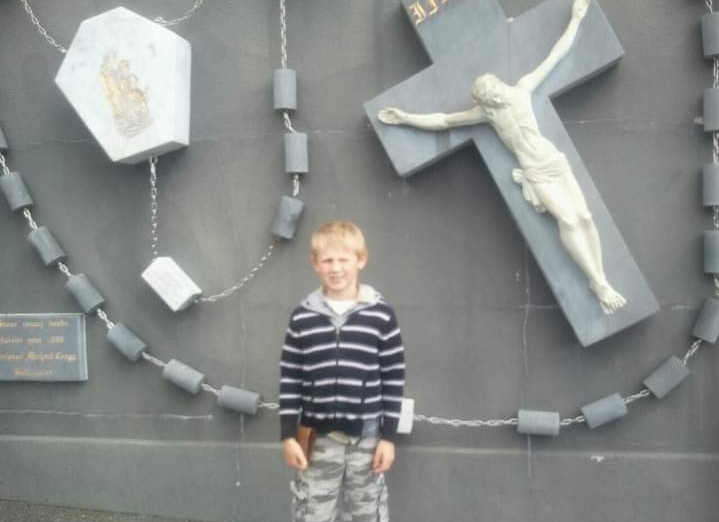
That reminds me of the day my grandson Ben, drank our bottle of holy water. He thought it was River Rock mineral water. I have to say he did have a bit of an obsession with Mass and the missions for a while afterwards. We brought him to Knock once and he insisted on having his picture taken with all the statues. However, the spiritual effects of drinking half a litre of holy water were short lived. Sigh!

EASTER SUNDAY
🐥People rose as early as sunrise to celebrate Easter Sunday. (That tradition hasn’t completely died.)
🐥After Easter Sunday Mass people attended a ‘herring procession’. Because so much fish (herring in particular) was eaten during Lent, butchers conducted these mock funerals to symbolize the end of Lenten abstinence. Some were known to whip the herring because they were so sick of eating it for 6 weeks.
🐥‘Spoilin meith na hlnide’ was a small piece of meat that people pinned on their wall during Lent. On Easter Sunday it was taken down and burnt to give a nice smell to the inside of the house.
🐥Boil and paint eggs or go on an Easter cludóg. An Easter cludóg was where people would come together and light a bonfire. They’d roast eggs on the fire and eat them saving the egg shells to plant at a May bush.
🐥This tradition lasted right through to the 80’s. Maybe later in some parts of the country. I’d like to know if and where people still have a traditional Easter Cludóg.

 Gloria McBreen