Bavarian – #ThursdayDoors

I love our (almost) yearly skiing holiday in Garmisch-Partenkirchen in Bavaria, Germany. It’s one of my favourite places to holiday. I’ve lost count of how many times I’ve visited Garmisch-Partenkirchen but I know I’ve had more skiing trips there than summer trips. I want my next visit to be a summer one though!

However, it’s a beautiful location at any time of the year. I don’t ski (not my thing). I go for snowy walks, watch the family skiing, drink Glühwein, read, and sometimes write. The mountain air is fresh and crispy cold, unlike the damp coldness we have in Ireland. And of course, the scenery is amazing.

I spent one morning walking around town taking photos of all the beautiful doors and buildings. I’ll never get bored looking at the buildings in Garmisch-Partenkirchen.

I have no history to tell you about all of the doors because most of them are just dwelling houses and restaurants, and any history behind them is unknown to me! As I always say about every door; they could tell a tale or two!

I had no idea this was a library until I was back home and I translated the word ‘bucherei’.

This little house (below) is adorable. Although, it’s not so little at all. Cute door!

The restaurants have very heavy doors. All similar but rarely two the same.

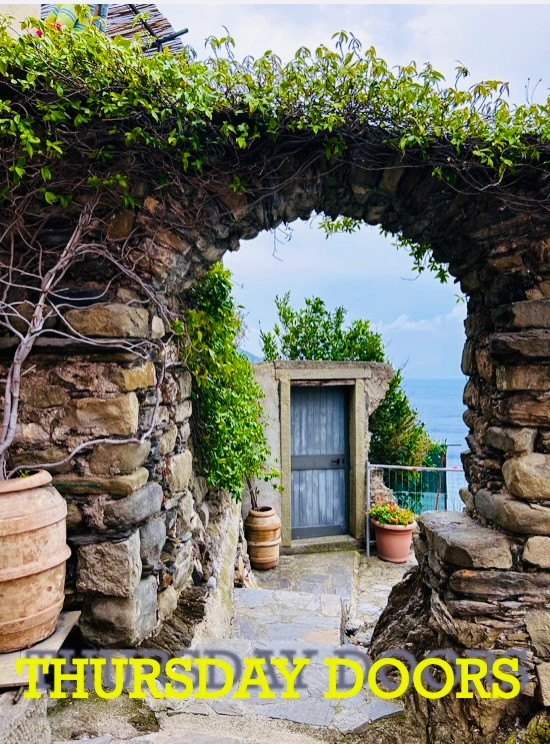
My last door for today is quite unusual and in my favourite colour!

Thursday Doors is a weekly challenge for people who love doors and architecture to come together to admire and share their favourite door photos, drawings, or other images or stories from around the world. If you’d like to join in and create your own Thursday Doors post each (or any) week, visit nofacilities.com for more information.
Thank you for visiting today! Before you go…

Would you like a peek inside the pages of my fictional novel? It might just be your cup of tea!

Set in a gossipy small town in Ireland at a time when marriage is for keeps and sexuality is repressed, Secrets in the Babby House is a family saga over three decades that starts in 1956. It is a story of love, deception, and stolen diaries filled with sins and secrets.
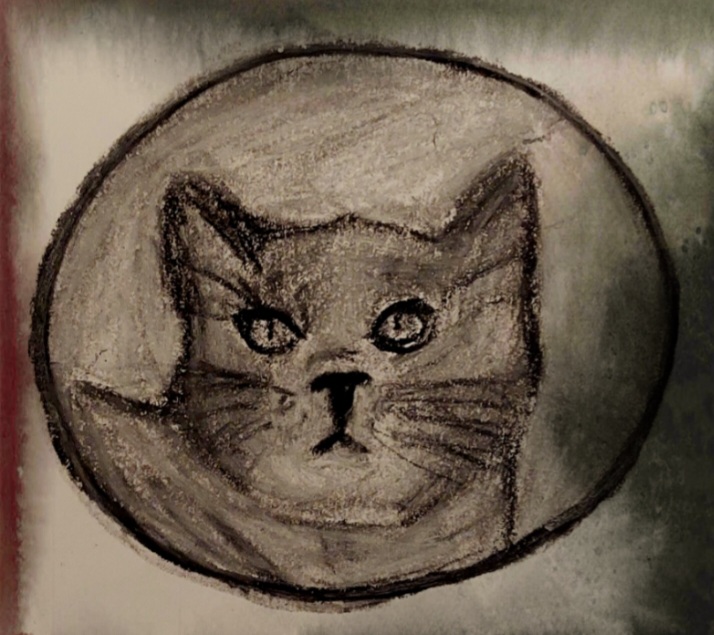
Centuries of Cats #100DaysOfOldDays

Day 52 #100DaysOfOldDays

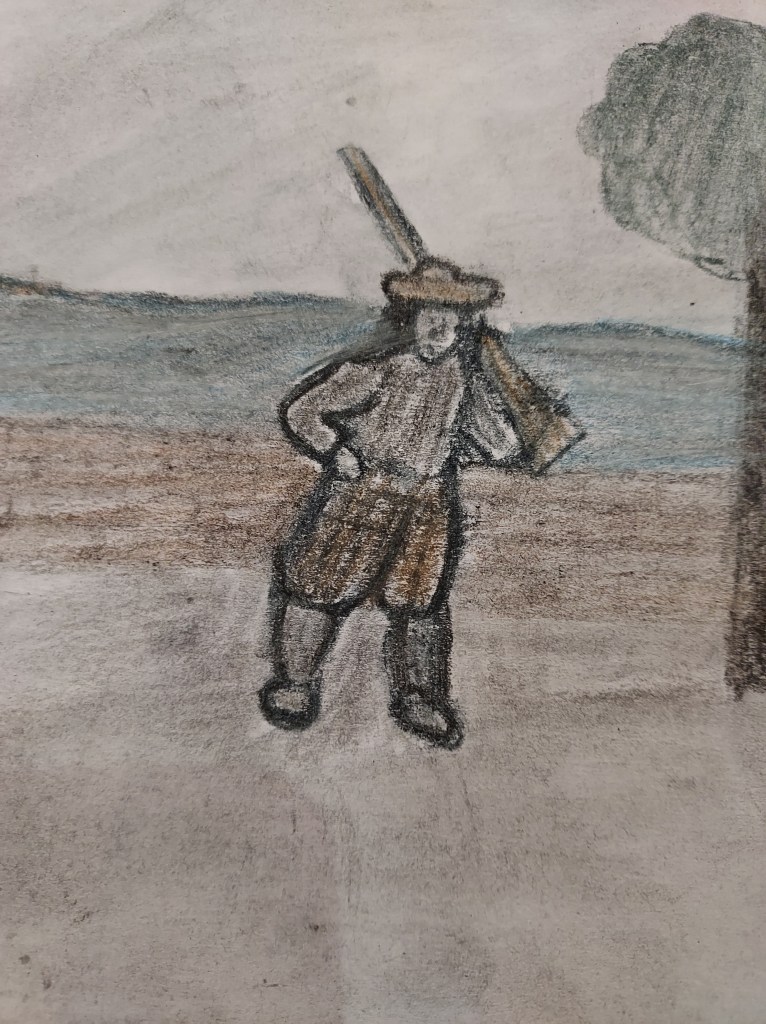
Like yesterday, Lucy drew a picture and asked me to relate it in some way to the old days.

As it happens, there’s lots to be told about our feline friends. Whether you’re a cat lover or not, I’m sure you’ll find the history of cats to be quite interesting.

Here’s a brief look at the life of cats down through the centuries.

Apparently cats existed for millions of years before dogs did—although dogs were domesticated long before cats were. Smilodon is one of the most famous pre-historic sabre-toothed tigers. Not the kind of cat you’d want lying on your favourite mat.

In Ancient Egypt, the Egyptians developed a relationship with cats when they became known for keeping rats and mice away from their food supplies. Over time, they became part of the Egyptian household and before long cats were seen as celestial creatures that were to be worshipped. Around this time it was illegal to export a cat from Egypt and to kill one resulted in the death penalty.

The Egyptians mummified their dead cats and buried them in consecrated plots. Researchers discovered 300,000 mummified cats in one such plot.

India, China and other Asian countries began to keep cats as pets too. They were still considered Godlike creatures and treated like royalty.

The Romans and Greeks didn’t worship cats but they did keep them as pets; more for their ability to keep the rodent population down. They became more domesticated over time as people saw them as a most suitable human companion.

In the 14th century, during the time of the Black Death, cats played an important role in keeping vermin under control, thus lessening the spread of the plague.

Cats weren’t treated so kindly during medieval times. They were still thought of as magical—but of a devilish nature. Not many kept one as a pet because it was believed that only witches kept cats. Anyone suspected of dabbling in witchcraft was put to death along with their cat. Cats weren’t welcome in most homes during the 17th century. They almost became extinct around this time.

Their decline in population during the return of the Black Death, meant a higher percentage of vermin scourged the streets and helped with the spread of the plague.

Some people believed that black cats were witches in disguise. And it was said that the black cat aided a witch in her spells and magic (a familiar). Hence the reason why we associate black cats with Halloween.

Lucky for all cats, witch hunts ceased to exist and people began to welcome them into their homes again.

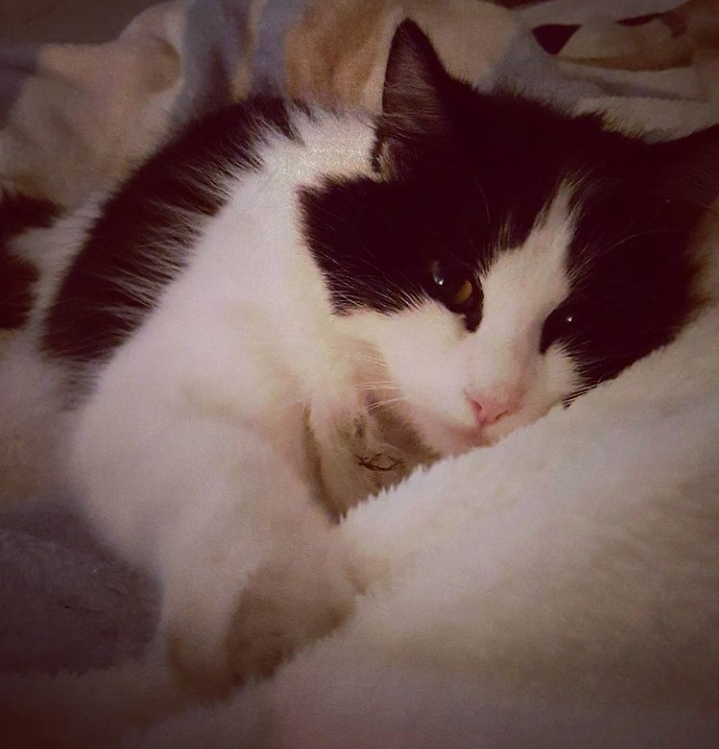
This is the gorgeous Malibu…my daughter’s pampered cat.

The First Mother’s Day #100DaysOfOldDays

Day 43 #100DaysOfOldDays

Everything has to start somewhere, including Mother’s Day!

In ancient times, Greece and Rome held a festival to honour their mother goddess—Cybele or Gaia, depending on the culture.

In England, Mother’s Day came about during the Middle Ages. People who had moved away from home developed the tradition of coming home to visit their mother church and their mothers, on the fourth Sunday of Lent. It became known as Mothering Sunday!

Because the first day of Lent varies from year to year, so does Mother’s Day.

In the US, the history of Mother’s Day is a different story.

It’s celebrated on the second Sunday in May each year in the US, and it started when a woman named Anna Jarvis held a memorial service for her mother on 12th of May 1907.

Her mother had often wished there was a day in the year that honoured mothers, so with the help of others, Anna petitioned to the government to make Mother’s Day an official holiday.

On May 8, 1914, President Woodrow Wilson signed a resolution, stating that Mother’s Day would be celebrated on the second Sunday in May.

Many other countries also celebrate Mother’s Day at different times of the year.

When The Moy Ran Red #100DaysOfOldDays

Day 25 #100DaysOfOldDays

Today’s post is also for Marsha Ingrao’s weekly Photographing Public Art Challenge (#PPAC)

✣ ✣ ✣

They say that the River Moy ran red with blood on the 23rd of September 1586, after the slaughter of almost 3,000 Scots, half of which were women and children.

The Battle of Ardnaree was a battle in the Tudor conquest of Ireland. (Ardnaree is a suburb in Ballina, Co Mayo in the West of Ireland.)

An Irish-Scottish mercenary army, led by Donnell Gorm MacDonnell of Carey and Alexander Carragh MacDonnell of Glenarm, sons James MacDonald, 6th of Dunnyveg, were invited into Connacht by the Mayo Burkes to attack English settlements and forces. This mercenary army was fronted at Sligo, Coolony and Ballingafad by English forces for over fourteen days.

The Gallowglass Scots camped for three nights on the banks of the River Moy en route to their final destination of Tyrawley in North Mayo. The governor of Connacht Sir Richard Bingham, and his army followed them there and surrounded their camp during the night. At 10am the following morning they launched their horrific attack.

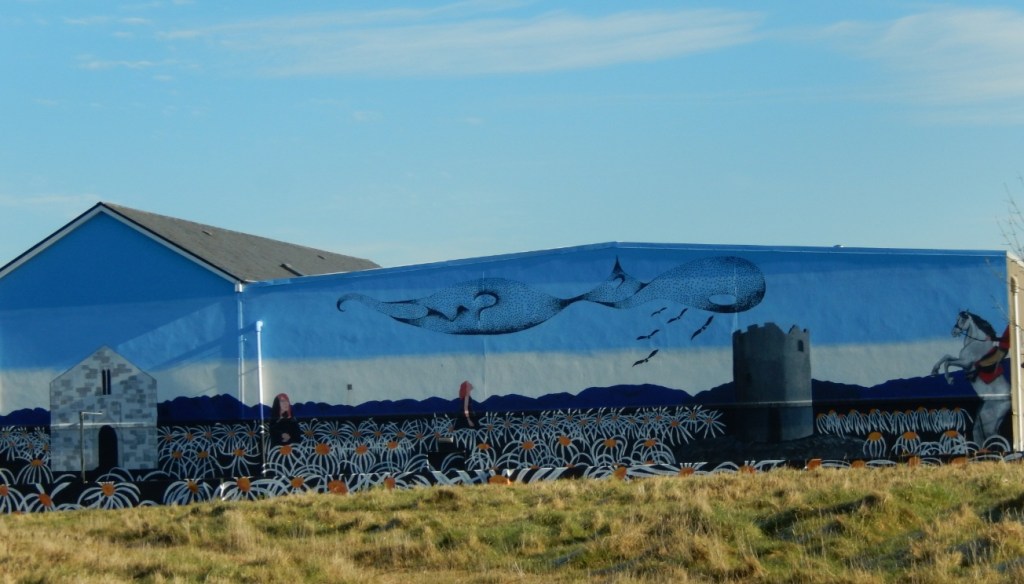
This mural portrays the tragic event that is The Battle of Ardnaree. It is part of a project carried out by the volunteers of Ballina Community Clean Up Group to commemorate the defeated Scots.

The artwork of the huddling starlings protecting themselves against the hawks, portrays the story of the Scots and their assailants. Also represented in the mural are the women and children who witnessed the bloodshed.

Artists: Brenna Rice – blueprint designer, landscape/skyscape artist. Megan McNamara portrait artist. Kevin Loftus – Augustinian Abbey architectural designer. Ciara Casey – Ardnaree Castle artist.

The full story of this historic day by Dermot Rice, is available to watch here on YouTube.